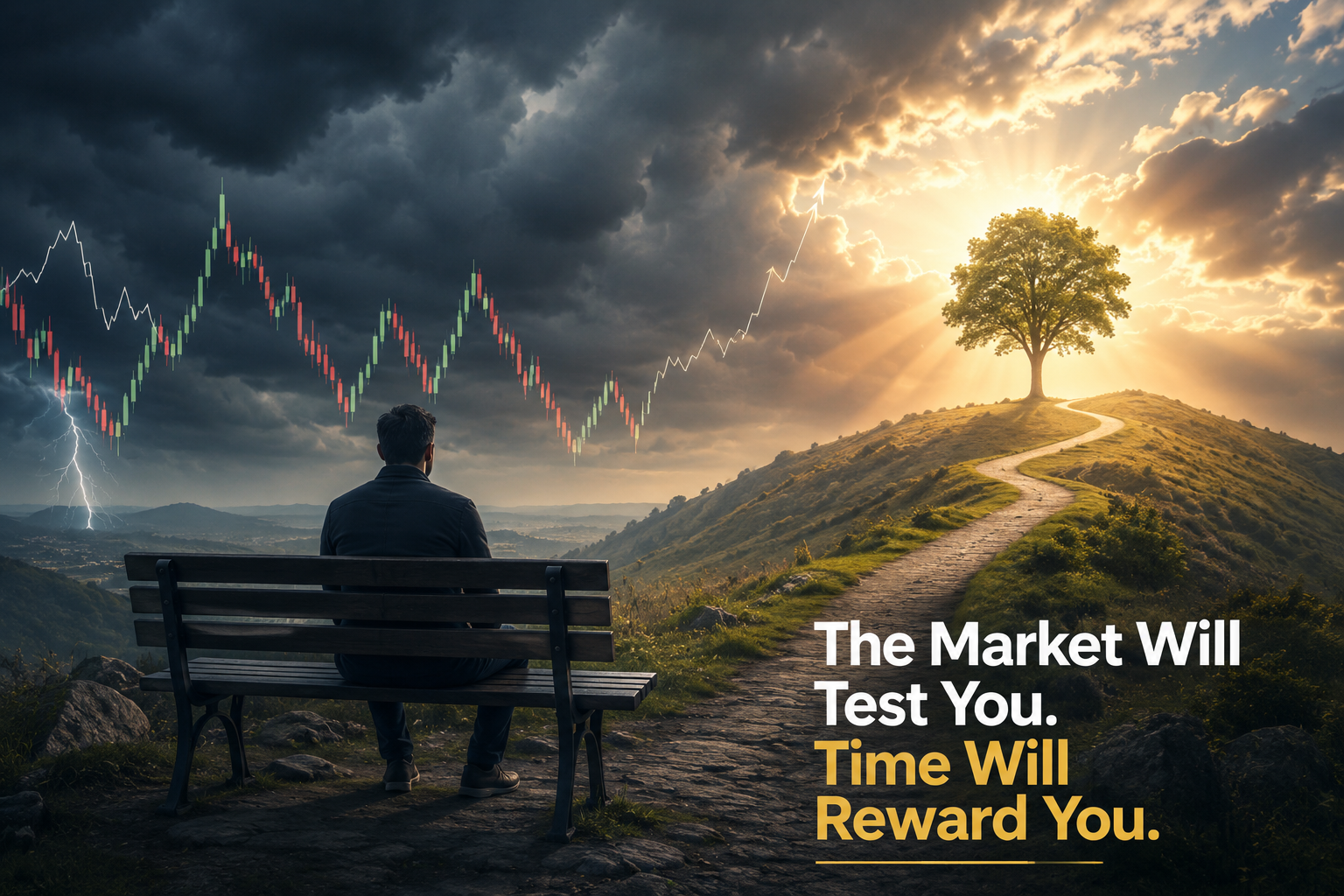
The Market Will Test You. Time Will Reward You.
Every investor eventually faces the same silent battle.
– Not against inflation.
– Not against interest rates.
– Not even against the market itself.
But against their own emotions.
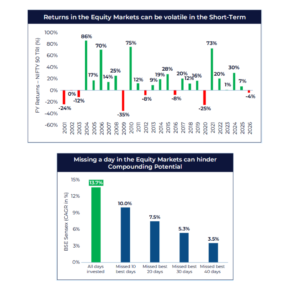
Because investing sounds logical in theory — until volatility arrives. Until headlines predict collapse. Until portfolios turn red. Until uncertainty becomes personal. Twenty-six years of Nifty 50 returns tell a story that no quarterly report ever will. Years of 86%, 75%, 73% sit alongside -35%, -25%, -24%.
And history shows this pattern repeating endlessly.
Markets have always moved in cycles of optimism and fear. Periods of extraordinary growth are often followed by painful corrections. Booms create confidence. Crashes create doubt. Yet over decades, wealth has rarely been created by those who reacted fastest. It has been created by those who endured longest.
The challenge is that markets never announce recovery in advance.
The strongest rallies often begin when sentiment is still pessimistic. The moments that feel safest to exit are frequently the moments closest to reversal. Investors waiting for clarity usually discover that clarity arrives only after prices have already moved higher.
As Morgan Housel writes:
“The highest returns come to those who can stay invested the longest.”
This is what makes investing less a financial skill and more a behavioural one.
Most people believe long-term investing is about intelligence, research, or timing. But in reality, long-term success is often determined by emotional stability. The ability to remain disciplined during uncertainty matters more than the ability to predict the next market move. An investor fully invested in the BSE Sensex over the long term earned a 13.7% CAGR. Miss just the 10 best trading days — often clustered around periods of peak fear — and your returns collapse to 10%. Miss 40 such days, and you are left with a fragile 3.5%. The cost of being absent is not linear. It is devastating.
Behavioral finance calls this myopic loss aversion — our tendency to react more strongly to short-term losses than long-term opportunity. Human psychology evolved to avoid danger immediately, not to patiently wait for compounding over decades.
And that is why investors struggle.
– When markets rise, patience feels easy.
– When markets fall, patience feels irresponsible.
But compounding has always demanded discomfort before reward.
Every major market cycle in history eventually became a test of conviction. The dot-com crash. The global financial crisis. The pandemic panic. Different triggers, same emotional pattern: fear convinces investors that “this time is different.”
And yet, over long periods, disciplined participation has consistently mattered more than perfect timing.
This does not mean investors should ignore risk. It means they must distinguish between volatility and permanent loss. Volatility is temporary uncertainty. Permanent loss often comes from abandoning a sound strategy at the worst possible moment.
Structured investing is not about predicting every correction. It is about building a framework strong enough to survive corrections without emotionally abandoning the process.
Because the real power of compounding is not mathematical alone — it is behavioural.
– Returns compound.
– But so does discipline.
– So does patience.
– So does consistency.
The market will always test investors before rewarding them.
And perhaps that is the price of long-term wealth: the ability to remain steady while the world around you becomes uncertain.
THE INVESTOR LESSON
- Volatility is normal, not exceptional.
- Emotional reactions often damage long-term returns more than market declines.
- Time in the market matters more than timing the market.
- Compounding works only for investors who remain invested long enough.
- Discipline is not built during calm periods — it is revealed during uncertainty.
CLOSING THOUGHT
The market’s short-term movements are loud, emotional, and unpredictable. But wealth creation has always been surprisingly quiet. It belongs not to those who constantly react, but to those who understand that patience is not passive — it is a strategy.
Recent Posts




Related Articles

ESG: The Cost of Ignoring What Doesn’t Show Up in Earnings
In January 2009, investors woke up to one of the largest corporate frauds in Indian history. For years, Satyam Computer Services was celebrated as a technology success story — revenues…..

When Technology Erases Demand: The Kodak–Silver Lesson
Did you know that Kodak once consumed nearly 50 million ounces of silver every year—roughly 20% of global supply—to coat photographic film with silver halides? At its peak in the…..

Investors Don’t Hate Volatility. They Hate Waiting Without Meaning
In the 1990s, a US airline faced a crisis: passengers complained endlessly about slow baggage delivery. Consultants proposed millions in new tech and faster belts. But one employee noticed something…..
Facing Difficulty in Your Investment Journey?
Talk to CERTIFIED FINANCIAL PLANNER® for Suitable Investment Options for You
REQUEST A CONSULTATION