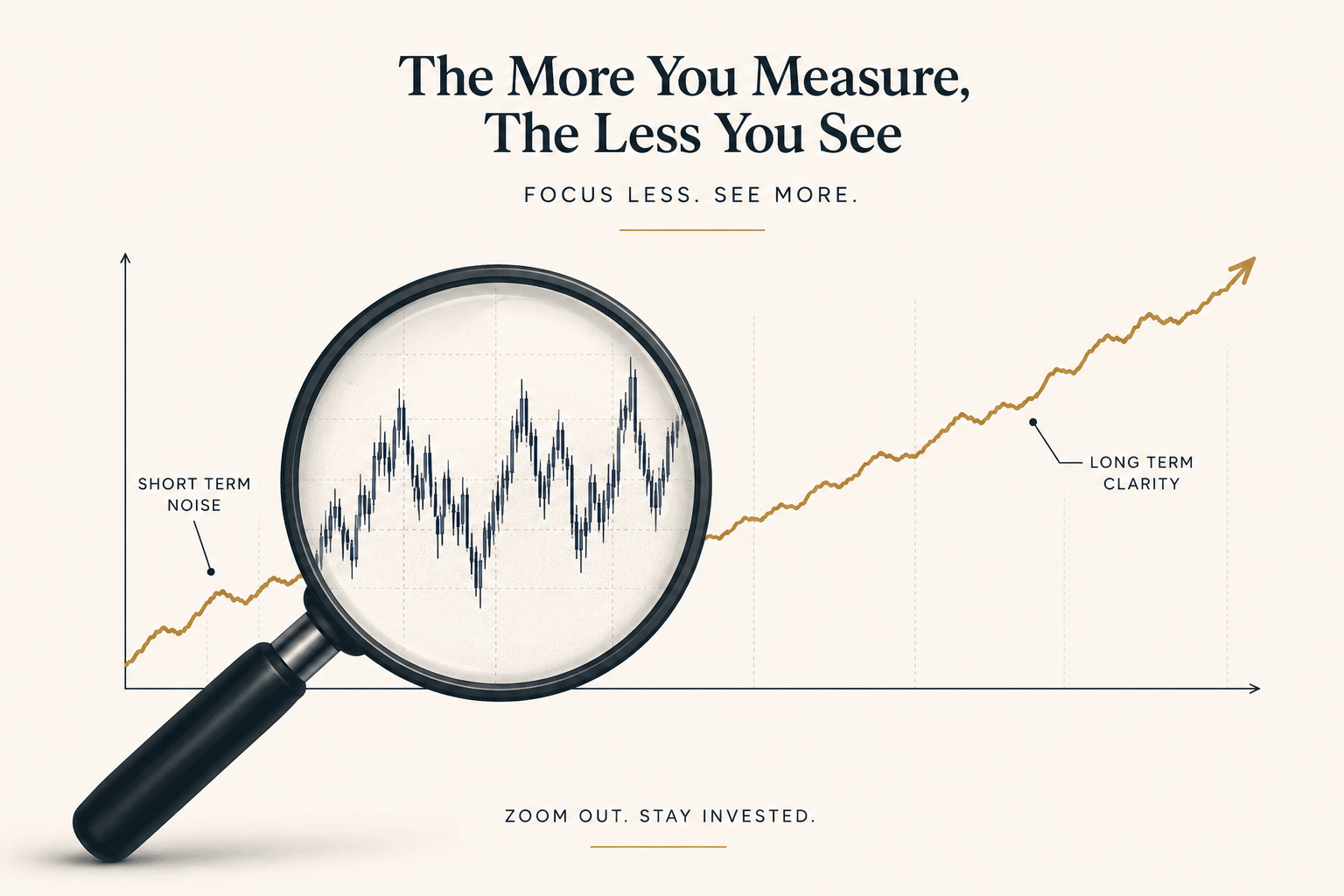
The More You Watch, The Less You See
The future becomes noisier when you stare at it daily.
In 1927, German physicist Werner Heisenberg introduced one of the most important ideas in modern science: the Uncertainty Principle.
At its simplest, the principle states that certain things cannot be measured precisely at the same time. The more accurately you try to determine a particle’s position, the less accurately you can know its momentum. And vice versa.
Often, the most anxious investors I meet are also the most informed ones. They track their portfolios daily. Some, hourly. They’ve read every headline, followed every correction in real time, and absorbed more market commentary than most fund managers see in a week. And yet — they’re more unsettled, not less.
That’s not a coincidence. When you check your portfolio every day, you don’t get more information. You get more noise. A 1.5% dip that would have meant nothing to your long-term plan suddenly demands an explanation. And then a reaction. And then regret, or relief, depending on what happens next.
The market hasn’t changed. You have. More data doesn’t always mean more clarity. There’s a term behavioural psychologists use: the illusion of control. The belief that if we just monitor something closely enough, we can tame it. Investors fall into this trap constantly — and understandably so. We’re trained to associate effort with results. Watch more, know more, decide better.
But investing doesn’t work that way. The future isn’t a puzzle waiting to be fully assembled before you can act. It’s a landscape that unfolds over time, at its own pace, regardless of how intently you observe it. The investors I’ve seen navigate volatility best are not the ones with the most data. They’re the ones with the clearest sense of what they’re trying to achieve — and the patience to let time do the heavy lifting. What Heisenberg actually taught us.
His great contribution wasn’t removing uncertainty from physics. It was helping us understand which uncertainties are real and permanent, and which ones are just noise we’ve mistaken for signal. That’s the work in investing too.
Some questions get clearer with more analysis — business quality, valuation, management track record. These are worth studying deeply.
Others only get clearer with time — market cycles, sentiment shifts, macro outcomes. No amount of monitoring speeds that process up. Often it slows you down.
The discipline is knowing which is which.
A simple test I offer clients:
When you feel the urge to react to something in your portfolio, ask yourself: Will this matter in five years? Not will it feel significant today. Not whether it’s making headlines. But whether the underlying business — or your financial plan — has actually changed in a meaningful way.
Most of the time, the honest answer is no.
Recent Posts




Related Articles
The Market Will Test You. Time Will Reward You.
Every investor eventually faces the same silent battle. – Not against inflation. – Not against interest rates. – Not even against the market itself. But against their own emotions. Because…..

ESG: The Cost of Ignoring What Doesn’t Show Up in Earnings
In January 2009, investors woke up to one of the largest corporate frauds in Indian history. For years, Satyam Computer Services was celebrated as a technology success story — revenues…..

When Technology Erases Demand: The Kodak–Silver Lesson
Did you know that Kodak once consumed nearly 50 million ounces of silver every year—roughly 20% of global supply—to coat photographic film with silver halides? At its peak in the…..
Facing Difficulty in Your Investment Journey?
Talk to CERTIFIED FINANCIAL PLANNER® for Suitable Investment Options for You
REQUEST A CONSULTATION